What a Computer Vision Engineer Does (and Pays)

What a computer vision engineer does day to day, where the jobs are in 2026, the skills and tools that matter, real salary data and how to break in.
Of all the jobs in AI, computer vision might be the one I find most exciting to explain, because you can actually see it working. A robot arm picks the right part out of a jumbled bin. A delivery robot stops for a dog it has never met. A scan gets flagged for a radiologist's attention before anyone has opened it. Behind every one of those moments is a computer vision engineer.
And in 2026, with physical AI moving from demo videos into warehouses, streets and hospitals, this is one of the most practical, future-proof specialisms you can pick. So, as with the rest of this series, I'll cover what a computer vision engineer actually does, where the jobs are right now, the skills and tools that matter, what it really pays, and how to break in.
What a computer vision engineer actually does
In one line: a computer vision engineer builds the systems that let machines understand images and video, and makes them work reliably in the messy real world, not just on a benchmark.
That last part is the whole job. Getting a detection model to look good on a clean test set is the easy bit. Getting it to work at dusk, in rain, under flickering factory lights, with a scratched lens, on a small chip that has to answer in a few milliseconds? That's where CV engineers earn their money.
A typical week looks something like this:
- Working with data. Deciding what images or video to collect, setting up labelling (bounding boxes, segmentation masks, keypoints), and hunting down the edge cases the model keeps getting wrong. Many CV engineers say this is half the job.
- Training and fine-tuning models. Detection, segmentation, tracking, pose estimation and depth models, increasingly starting from large pre-trained vision or vision-language models rather than training from scratch.
- Classic vision and geometry. Camera calibration, stereo, 3D reconstruction and sensor fusion with lidar or radar. The deep learning gets the headlines, but the maths of cameras still matters.
- Optimising for deployment. Shrinking and speeding up models so they run on an edge device, a robot or a camera, not just a big cloud GPU.
- Evaluating and monitoring. Measuring precision and recall on the cases that matter, and catching drift when a factory changes its lighting or a hospital buys a new scanner.
If you've read our machine learning engineer guide, you'll notice the overlap. The simplest way I put it: a CV engineer is an ML engineer who specialises in pixels, cameras and the physical world, and who has to care about hardware far more than most.
Where computer vision engineers work in 2026
Ten years ago, CV jobs clustered in a handful of research labs and phone makers. Today the work is everywhere a camera meets a decision. These are the five areas I'd watch.
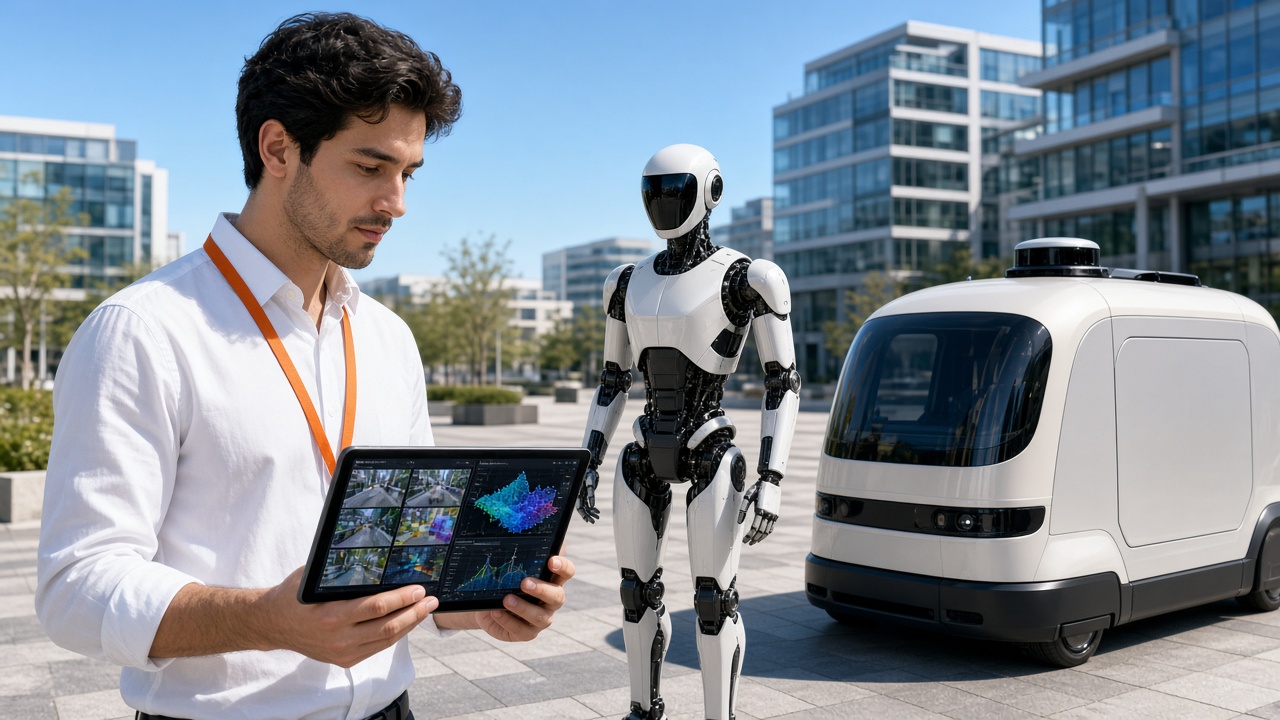
Robotics and physical AI. This is the big one. Every warehouse robot, humanoid and autonomous mobile robot needs to see, and vision is usually the hardest part of the stack. The AI Hiring Index's weekly report for the seven days to 12 November found robotics named in 10.9% of open AI job descriptions it tracks, behind only Python, LLMs and agents (AI Hiring Index). We covered the wider trend in the physical AI hiring wave.
Autonomous vehicles. Robotaxis are no longer a someday story. On 27 October Waymo said it was adding nearly 250 square miles of service across Los Angeles, Nashville, Orlando, San Diego and the San Francisco Bay Area over the following week (Waymo). Every new city means more perception work: new road layouts, new weather, new edge cases. And the same skills transfer to delivery robots, trucking, drones and agriculture.
Manufacturing and quality inspection. Camera-based inspection checks welds, circuit boards, packaging and food on the line, around the clock. It's less glamorous than robotaxis, but it's where a lot of steady, well-paid CV work lives, with a clear return on investment.
Healthcare imaging. Medical imaging is the most mature commercial home for computer vision. The FDA says it has authorised more than 1,600 AI-enabled medical devices as of September 2026 (FDA), and by Kent Applied's count of the FDA list, 1,230 of the 1,614 listed devices (76.2%) sit under the radiology panel (Kent Applied). That's a huge amount of image analysis, and it's work where careful evaluation and regulatory discipline are valued as much as model skill.
Retail and smart spaces. Shelf monitoring, checkout-free stores, footfall analytics and parking systems all run on vision.
The skills and tools that matter
Here's the toolkit I see in strong CV job ads and in the engineers who get hired quickly.
- Python and C++. Python for research and training; C++ when the model has to run fast on a robot or camera. Being comfortable in both is a real differentiator.
- Deep learning frameworks. PyTorch is the default in most teams, with TensorFlow still around. Know how convolutional networks and vision transformers work, not just how to call them.
- Core CV libraries. OpenCV for the classic image-processing and geometry work, plus popular open-source detection and segmentation toolkits.
- Foundation and multimodal models. Fine-tuning pre-trained vision models and using vision-language models for labelling, search and zero-shot tasks is now an everyday skill.
- Edge deployment. Quantisation, pruning, ONNX export and GPU or accelerator runtimes. Our inference engineer guide goes deeper on that side.
- 3D and sensors. Calibration, point clouds, SLAM and sensor fusion, especially for robotics and autonomous vehicles.
- Data tooling. Labelling platforms, dataset versioning and synthetic data from simulation. Robotics teams increasingly generate rare scenarios in simulators.
- Maths. Linear algebra, probability and projective geometry. You don't need to be a mathematician, but you do need to understand why your model fails.
What a computer vision engineer earns
Pay data for CV is noisier than for broader titles, so I'll give you several sources and be clear about what each measures. All figures are US dollars unless stated.
- Indeed: an average base salary of $148,881 for computer vision engineers in the United States, from 470 salaries in job postings over the past 36 months, updated 7 November 2026. The typical range runs from about $89,000 to $248,000, and the highest-paying cities listed are San Jose ($197,482), San Francisco ($194,519) and Austin ($192,402) (Indeed).
- Glassdoor: a median total pay of about $173,000, with a 25th to 75th percentile range of roughly $132,000 to $230,000, based on 435 anonymous salary reports (Glassdoor). Total pay includes bonus and other additional pay, which is why it's higher than base-only figures.
- PayScale: an average base of $127,762 in 2026, with entry-level engineers (under a year's experience) averaging about $102,000 in total compensation and those with one to four years about $123,000 (PayScale).
- Levels.fyi doesn't publish a separate computer vision median, so the closest proxy is its ML/AI software engineer track: a $250,000 median total compensation (base, stock and bonus) from 5,946 reports, last updated 26 October 2026 (Levels.fyi). That's skewed towards big tech and AI labs, where stock is a big part of the package.
- UK: IT Jobs Watch puts the median advertised salary at £60,000 for the six months to 12 November 2026 (IT Jobs Watch). Treat that one with care, as it's based on only 15 quoted salaries, and many UK vision roles are advertised under broader ML or robotics titles.
My read: a solid mid-level CV engineer in the US should expect a base in the $130,000 to $190,000 band, with the big jumps coming from three things. Seniority, obviously. Working at a company where vision is the product (robotics, autonomy, chips), where packages run well above the averages. And rare skills like 3D perception, sensor fusion or squeezing models onto edge hardware.
How to break in
Computer vision rewards people who can show working systems, so here's how I'd approach it from three starting points.
If you're a software engineer: you already have the engineering discipline. Learn the CV fundamentals, then build something end to end: a detection model trained on your own collected dataset, deployed to a cheap edge board or a phone, running in real time. Write up the frame rate, the accuracy and what broke.
If you're a graduate or career changer: pick one domain and go deep. Inspection, sports analytics, agriculture or medical imaging all have public datasets. A project that says "I improved defect recall from 0.82 to 0.91 by fixing my labels and adding synthetic data" will beat a generic tutorial clone every time. And don't overlook adjacent ways in, such as robotics technician, data labelling lead or test engineer roles at robotics and autonomy companies, which can turn into CV roles.
If you're an ML engineer or data scientist: close the physical-world gap. Learn camera calibration, basic 3D geometry and deployment on constrained hardware. Those skills are what separate a CV specialist from a generalist who has trained an image classifier.
For everyone: build a portfolio that moves. Short videos of your model working (and failing) say more than any CV bullet point. And keep an eye on our jobs board to see which skills employers are naming right now.
My take
People sometimes ask me whether big multimodal models will make computer vision engineers less necessary. I think it's the opposite. Foundation models make it faster to get to a first working version, which means far more companies will attempt vision projects. But the hard part, getting from 95% to 99.9% reliability on a robot, a car or a hospital scanner, still needs people who understand cameras, data and the real world. That's where the value sits, and it's a skill set that only gets more useful as physical AI scales.
The bottom line: computer vision engineers teach machines to see. Python, PyTorch and OpenCV are the base, deployment and 3D skills are the multiplier, and a relentless focus on edge cases is the superpower. If you love seeing your work come alive in the physical world, this is one of the most exciting jobs of the decade.
Sources
- Indeed: Computer vision engineer salary in United States (updated 7 November 2026)
- Glassdoor: Computer Vision Engineer salaries
- PayScale: Computer Vision Engineer salary
- Levels.fyi: ML / AI Software Engineer salary (updated 26 October 2026)
- IT Jobs Watch: Computer Vision Engineer, UK (six months to 12 November 2026)
- AI Hiring Index: Weekly report, 7 days to 12 November 2026
- Waymo: From the road, 27 October 2026
- FDA: Artificial Intelligence-Enabled Medical Devices
- Kent Applied: AI-enabled medical devices on the FDA's list, by specialty and year