The AI Jobs That Wear Hard Hats: Data Centre Hiring Boom
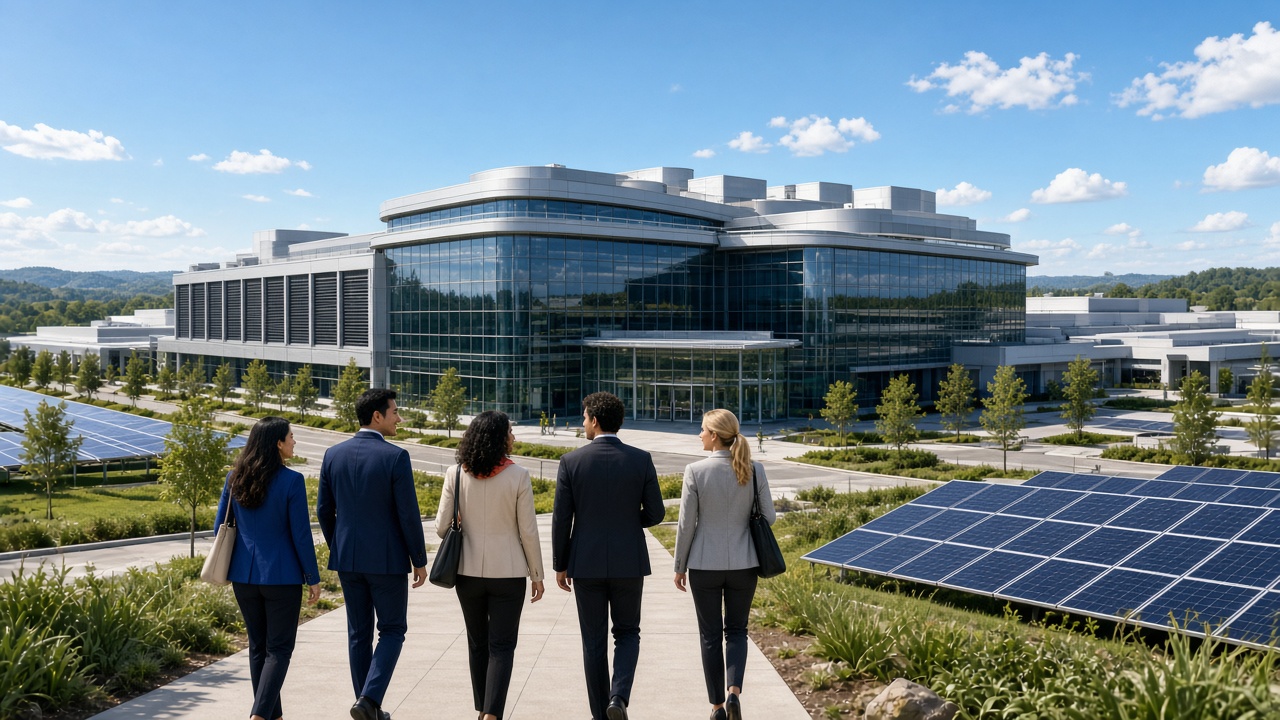
Data centre construction is up 81% in a year, trade pay is rising fast and new training programmes are launching. Here's where the hands-on AI jobs are.
When people talk about AI jobs, they usually picture someone at a laptop fine-tuning a model. This week I want to talk about a different AI job, one that comes with steel-toe boots, a hard hat and, increasingly, a very healthy pay packet. Because the freshest hiring news of November 2026 isn't coming from a lab. It's coming from the building sites and control rooms of the data centres that AI runs on.
Three things landed in the last fortnight that, together, tell a really clear story. The US Census Bureau's latest construction figures, a new KPMG Economics analysis of trade wages, and a run of new training partnerships from data centre operators and colleges. Put them side by side and you get one of the most practical career opportunities of the AI era, and most of it doesn't need a computer science degree.
The money has to go somewhere physical
Start with the scale. Amazon said on 29 October that it still expects about $220 billion of cash capital spending in 2026 (Amazon). Alphabet, Meta and Microsoft have all guided to spending well above $100 billion each this year too, as Post Labor Economics summarised from the companies' October earnings (Post Labor Economics).
Some of that buys chips. A huge amount buys concrete, switchgear, transformers, chillers and miles of copper, and someone has to install all of it. The Census Bureau's construction release on 2 November showed private data centre construction running at a seasonally adjusted annual rate of $88.8 billion in August 2026, up from $49.1 billion a year earlier. That's an 81% jump in twelve months, and the first estimate for September was higher again at $96.5 billion. Over the same year, total US construction spending was down 0.7% (Post Labor Economics, from Census Bureau data).
Read that again: data centres are carrying a big chunk of an otherwise flat construction industry. That's where the jobs are being created.
What the hiring data says
The most striking chart I saw this week compares two kinds of job postings on Indeed. Software development postings sit at 80.8% of their February 2020 level, while construction postings sit at 129.2%, according to Indeed Hiring Lab data published through the St. Louis Fed and charted by Post Labor Economics as of 23 October (Post Labor Economics). I'm not saying software is dead (far from it, and we track plenty of strong software hiring on this site). But it's a useful reminder that the AI economy has two halves, and the physical half is hiring hard.
The contractors confirm it. In the Associated General Contractors of America's 2026 workforce survey with NCCER, which drew 1,830 responses in July and August, 28% of firms had worked on a data centre project in the past year. Of those, 58% said data centres had increased competition for skilled workers and 49% reported more wage pressure. Electricians topped the list of hardest-to-hire trades, followed by HVAC technicians, pipefitters and welders (HRD America).
Electrical work is the heart of it. According to the IBEW, between 45% and 70% of a typical data centre's construction budget goes to the electrical subcontractor, Nils Daniels of data centre recruiter Fabraworks wrote in Electrical Trends on 3 November. He also cited the Associated Builders and Contractors' August backlog indicator: a record one in six ABC members now hold data centre contracts, and those firms carry 9.9 months of backlog against 8.3 for everyone else (Electrical Trends).
Yes, it pays
This is the bit I love, because it's genuinely good news for working people. KPMG Economics published an analysis on 3 November looking at the twelve US states with the most data centre construction. From early 2024 to early 2026, weekly pay for equipment trades such as electricians and plumbers in those states rose nearly 7% a year, compared with about 4% across all industries nationwide (KPMG). KPMG also notes that its wage data stops in early 2026, and data centre construction has sped up since.
At the local level, a Midwest workforce director told Daniels that jobs on a nearby hyperscale campus start around $25 an hour, against about $18 in local manufacturing, and that people trained for that campus were still there two or three years later because the building kept going (Electrical Trends).
And the long-run picture is solid. Post Labor Economics, citing the Bureau of Labor Statistics, reports that electricians earned a median $63,190 in May 2025, with the top tenth above $108,510, and BLS projects 9% job growth from 2025 to 2035 with about 72,700 openings a year. Line installers and repairers, who build the power connections these campuses need, earned a median $95,320. Both typically start with a high school diploma and an apprenticeship, not a degree (Post Labor Economics).

The training pipeline is finally getting built
Here's the honest constraint: you can't conjure a qualified electrician in a quarter. The Alliance for America's Skilled Trades found that training programmes produce 55 workers for every 100 needed, as cited in the Electrical Trends piece. And AGC's Macrina Wilkins put it bluntly: higher wages alone mostly move the same workers between employers, so the real lever is training more people (HRD America).
The encouraging news is that the industry is starting to act on that. Just this week:
- Serverfarm and Arkansas Tech University-Ozark announced on 11 November a 180-hour critical facilities training programme starting in January 2027, with 128 hours of hands-on lab and simulation work and 52 hours in the classroom covering electrical power, cooling, backup systems, controls and maintenance. No prior data centre experience is needed, eligible students can have training costs covered by an Arkansas scholarship, and it's the first step towards a proposed associate degree in Critical Facilities Technology in autumn 2027. Serverfarm says its Clarksville campus will bring more than 2,000 construction jobs and 200 permanent Serverfarm jobs (River Valley Democrat-Gazette).
- National Technical Institute launched a 64-hour Data Center Technician programme at its Phoenix campus, with evening classes and the first cohort starting 18 November. Graduates are guaranteed an interview with NTI's data centre partner for roles in Central Arizona (CCR).
Big tech is funding the same channels. Amazon's Q3 release introduced Built Together, a $1 billion community investment in US data centre communities that includes free community college and trades training (Amazon). Google.org has committed $50 million to trades training, around $20 million of it to the Electrical Training Alliance, and Microsoft runs a programme that trains electricians around its data centre projects (Post Labor Economics; HRD America).
Where automation people fit in
You might be wondering why a site about AI and automation careers is writing about electricians. Two reasons.
First, a modern data centre is one of the most automated buildings on earth. Once construction finishes, it runs on building management systems, power monitoring, controls, sensors and alarms, and more of it is being handled by robots and AI-driven monitoring every year (we covered that in our data centre robotics engineer guide). Look at what Serverfarm is teaching: power, cooling, backup systems and controls. If you have PLC, SCADA, BMS or industrial automation experience, you're closer to these roles than you might think.
Second, these jobs are a brilliant bridge for people whose current roles are being reshaped by AI. A critical facilities technician role, commissioning work or a controls apprenticeship sits right where physical skills meet automation, and it's work that can't be done from a server rack.
My take
I'm genuinely optimistic about this. For years the AI jobs conversation has been framed as "will a model take my job?". The data centre buildout flips that: AI is creating a big wave of well-paid, local, hands-on construction jobs, plus a new wave of technician and controls roles that blend trade skills with automation. Yes, there are growing pains. KPMG points out that the competition for trades is pushing up costs for other building projects, and one economist told Daniels that perhaps only one in three announced projects actually goes ahead. So I'd follow confirmed construction, not press releases.
My practical advice:
- If you're starting out or switching careers: look hard at electrical, HVAC and critical facilities apprenticeships and short technician courses near a campus that's actually being built. You earn while you learn.
- If you're in industrial automation or controls: start positioning yourself for data centre BMS, power monitoring and commissioning roles. Learn the vocabulary of power and cooling redundancy.
- If you're an employer: partner with a local college now. The companies training their own crews will be the ones that hit their schedules.
The AI era needs people who write code, and it needs people who wire the buildings where that code runs. Both are AI jobs. Browse our jobs board to see what's open.
Sources
- Amazon: Amazon.com Announces Third Quarter Results (29 October 2026)
- Post Labor Economics: The data center electrician is the new software engineer (1 November 2026, citing US Census Bureau, Indeed Hiring Lab via FRED, and BLS data)
- KPMG Economics: AI's hidden costs (3 November 2026)
- Electrical Trends: Data Centers Crowd Out Ordinary Work (3 November 2026)
- HRD America: The profession AI is hitting the hardest (21 October 2026, on the AGC and NCCER 2026 Workforce Survey)
- River Valley Democrat-Gazette: ATU-Ozark, Serverfarm launch data center career training program (12 November 2026)
- CCR: National Technical Institute Launches Data Center Technician Program in Phoenix