New AI Certifications Worth Your Time: November 2026
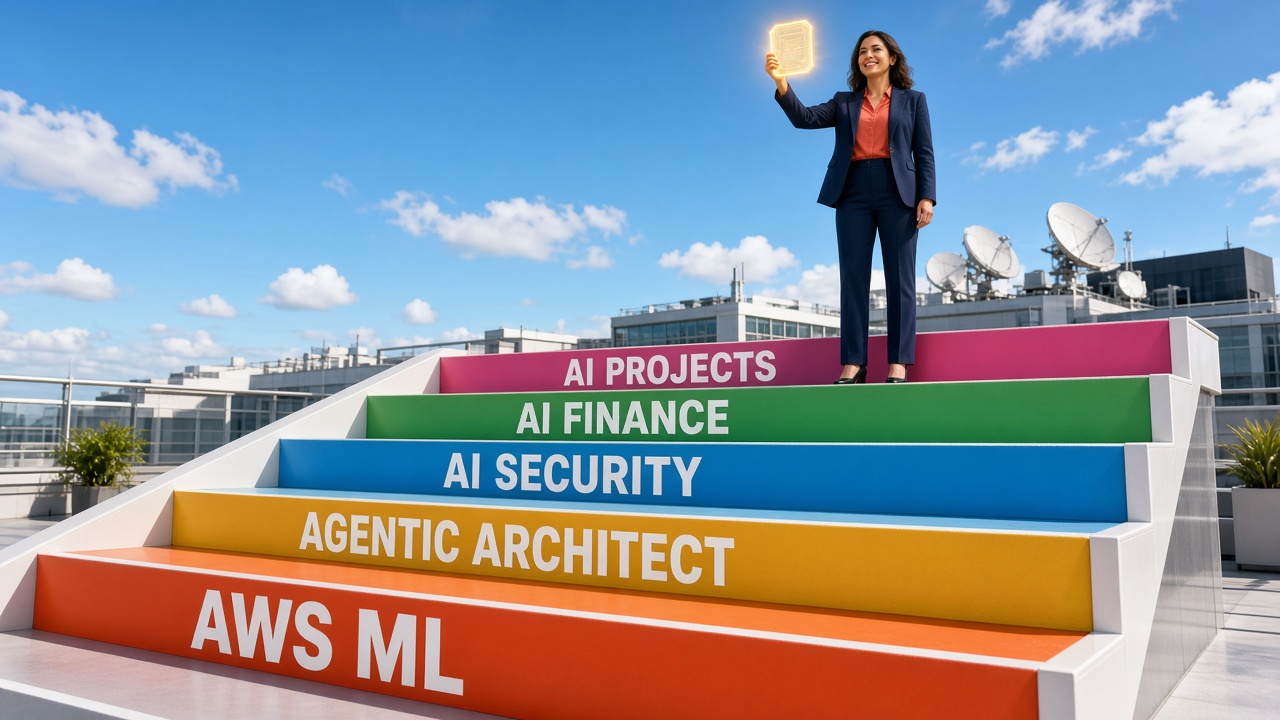
Google's new Agentic Architect exam, AWS MLA-C02, ISC2 AI security, CFI's AIFP and APM's AI certificates: who each is for, costs and which to pick.
Every few weeks someone asks me the same question: "Brett, are AI certifications actually worth it, or should I just build things?" My honest answer has always been both. Build things, because that's what gets you hired. But a good certification is a cheap, fast way to tell a recruiter (and the screening software in front of them) that you know your stuff before they've read a single line of your GitHub.
And November 2026 has been a genuinely interesting month for AI credentials. In the space of a fortnight we've had Google open up the agent certification it uses to train its own engineers, a finance body launch an AI certification for analysts, the UK's project management association bring out two AI certificates, and ISC2 move its new AI security credential into a pilot. AWS has also refreshed its machine learning exam to include agents and foundation models.
What I love about this list is the spread. This isn't only about engineers any more. Finance people, project managers and security professionals are all getting their own AI credentials, which tells you where hiring is heading: AI skills are becoming part of almost every professional job, not a niche specialism.
So here's what's new, who each one is for, what it costs where that's public, and my take on whether it's worth your time.
1. Google Cloud Professional Agentic Architect
Who it's for: developers, cloud architects and engineers who design and deploy AI agents.
This is the headline launch. On 11 November, Google Cloud announced the Professional Agentic Architect certification as part of its Gemini Agent Ready (GEAR) programme. The interesting bit is where it came from. Google says that over the past four months it trained thousands of its own forward deployed engineers and partners on this curriculum internally, and it's now opening the same certification to everyone.
The format is the part I'd pay the most attention to. It's not just a multiple-choice exam. There are two parts:
- A proctored multiple-choice exam on system design, architecture standards, cost optimisation and security governance.
- Hands-on labs in a live cloud environment, where you build, test and debug agentic workflows.
It covers five domains: building agents with low-code tools, using coding agents for app development, developing custom agents with open-source frameworks, evaluating and deploying agentic workflows, and securing and governing them.
On cost, the independent tracker AI Skill Atlas reports that the generally available version is a two-hour exam at US$200 (the beta was three hours at US$120). Check Google's own page before you book, as pricing can vary by country.
My take: this is the one I'd prioritise if you work anywhere near agents. Hands-on labs make it much harder to pass by cramming, so it means more to an employer. And the fact that Google trains its own forward deployed engineers on it says a lot about how close it is to real work. Google also quotes its own research with Ipsos saying 82% of learners using Google Skills found that listing Google Cloud certifications on their resume brought more recruiter responses. That's a vendor survey, so take it as a signal rather than gospel, but it matches what I see: recruiters search for certification names.
If you're new to this space, our guide to what an AI agent engineer does is a good primer.
2. AWS Certified Machine Learning Engineer – Associate (MLA-C02)
Who it's for: ML engineers, MLOps engineers, data engineers, and developers adding AI to apps.
This isn't a brand-new certification, but it's a big refresh, and the timing matters. AWS explains that the ML engineer role has changed: today's ML engineers don't just train traditional models, they implement generative AI, fine-tune foundation models, build retrieval-augmented generation (RAG) systems and orchestrate agentic workflows. The new MLA-C02 version adds all of that, plus wider Amazon Bedrock coverage and updated responsible AI content.
The beta is live now in English: 85 questions, 170 minutes, US$75, through Pearson VUE at a test centre or online. According to AI Skill Atlas, the full version becomes generally available in all languages on 14 January 2027.
My take: the beta is excellent value. US$75 for a credential that proves you can do both classic ML and GenAI on the biggest cloud is a bargain, and it lines up neatly with what employers are posting for machine learning engineers right now. If you're already on AWS, book it.
3. ISC2 AI Security Certification (pilot)
Who it's for: experienced cybersecurity professionals who secure AI and ML systems.
ISC2, the organisation behind the CISSP, released the pilot exam outline for its new AI security certification on 26 October. It covers six domains: AI concepts and security fundamentals; governance, ethics, risk and compliance; data management, privacy and model security; secure AI architecture, engineering and identity and access management; secure AI operations and incident response; and AI threats, testing and lifecycle management.
This month ISC2 confirmed that more than 12,000 volunteers have registered to help develop it, applications for the pilot exam have closed, and more than 3,000 selected candidates will sit the pilot from mid-December through to 24 January 2027. If the pilot goes well, the certification launches in 2027.
The proposed experience requirement is a minimum of four years of paid, full-time work in cybersecurity or AI-related fields, including two in cybersecurity. An active CISSP (or several other ISC2 credentials) can substitute for the whole experience requirement.
My take: you can't sit this one yet, but you can prepare. ISC2 has published the outline and suggested references, and when it launches in 2027 it's likely to carry real weight because ISC2 is so well known in security hiring. If you want to be an AI security engineer, start working through those domains now so you're ready on day one.
4. CFI AI Finance Professional (AIFP)
Who it's for: financial analysts, FP&A teams, bankers and anyone doing analysis and modelling.
On 9 November, the Corporate Finance Institute launched the AI Finance Professional (AIFP) certification. It teaches finance professionals to use AI across the whole workflow, from gathering data to analysis, modelling, presenting and recommendations. Crucially, it also covers checking AI-generated results, spotting errors and protecting sensitive financial information.
The programme has 11 required core courses (22 in total), optional AI practice labs, and a proctored final exam with a 70% pass mark. It's self-paced, online, and included in CFI's annual memberships.
CFI's launch cites PwC's 2026 Global AI Jobs Barometer, which found that jobs requiring AI skills are growing at 69%, compared with 9% across the overall job market.
My take: I really like the emphasis on verifying AI output. That's the skill employers are nervous about, and it's exactly what separates a professional who uses AI well from one who pastes in whatever the model says. If you're in finance and want to move towards AI-heavy roles, this is a sensible, practical step.
5. APM AI certificates for project professionals
Who it's for: project managers, PMOs and delivery teams.
The Association for Project Management (APM) in the UK has launched two new AI certificates: AI Awareness for Project Professionals and Working with AI in Project Teams. APM partner Provek, one of the first training providers to offer them, lists what they cover: essential AI concepts, choosing and using AI for project work, responsible AI in delivery and governance, checking AI-generated outputs, data readiness, human–AI collaboration, and governance and assurance for AI-enabled teams. The courses run as one-day sessions.
My take: short, practical and well-timed. Every big automation programme needs someone who can run it, and project managers who understand AI's strengths and limits are going to be in demand for a long time. If that's you, a one-day certificate is an easy win.
Also worth knowing
A few other changes from the past month, via AI Skill Atlas:
- Anthropic is updating three of its Claude certification exams on 7 December, with new exam guides due on 17 November. These are currently available through Claude Partner Network organisations.
- Microsoft's AB-100 exam changes on 16 November, with more weight on planning and design.
- SAP is offering one free attempt at its Joule Studio Developer exam if you use it by 31 December.

How I'd choose (practical advice)
There's no point collecting badges for the sake of it. Here's how I'd think about it:
- Pick the one closest to your next job, not your current one. If you want to move into agent work, it's Google's Agentic Architect. If you're a data engineer eyeing ML, it's AWS MLA-C02.
- Favour hands-on formats. Labs and practical exams carry more weight with hiring managers because they're harder to fake.
- Pair it with a project. Pass the exam, then build something small with the same skills and write it up. A certificate plus a working demo is a very strong combination.
- Put the exact certification name on your profile. Recruiters and screening tools search for exact names, so write them out in full.
- Watch the dates. Several exams change in the next few weeks, so check which version you'll be sitting before you start studying.
The bigger picture
What excites me about this month's launches is what they say about the market. A year or two ago, "AI certification" mostly meant a cloud ML exam. Now finance, project management and security all have their own, and the top engineering certification is built around agents and tested with live labs. AI is becoming a core skill across professional work, and the people who can prove they use it well are going to have a great few years.
If you've just earned one of these, put it to work. Browse the latest AI and automation jobs on AutomationRoles.ai, and create a talent profile so employers can find you.