What a Data Centre Robotics Engineer Does (and Who's Hiring)
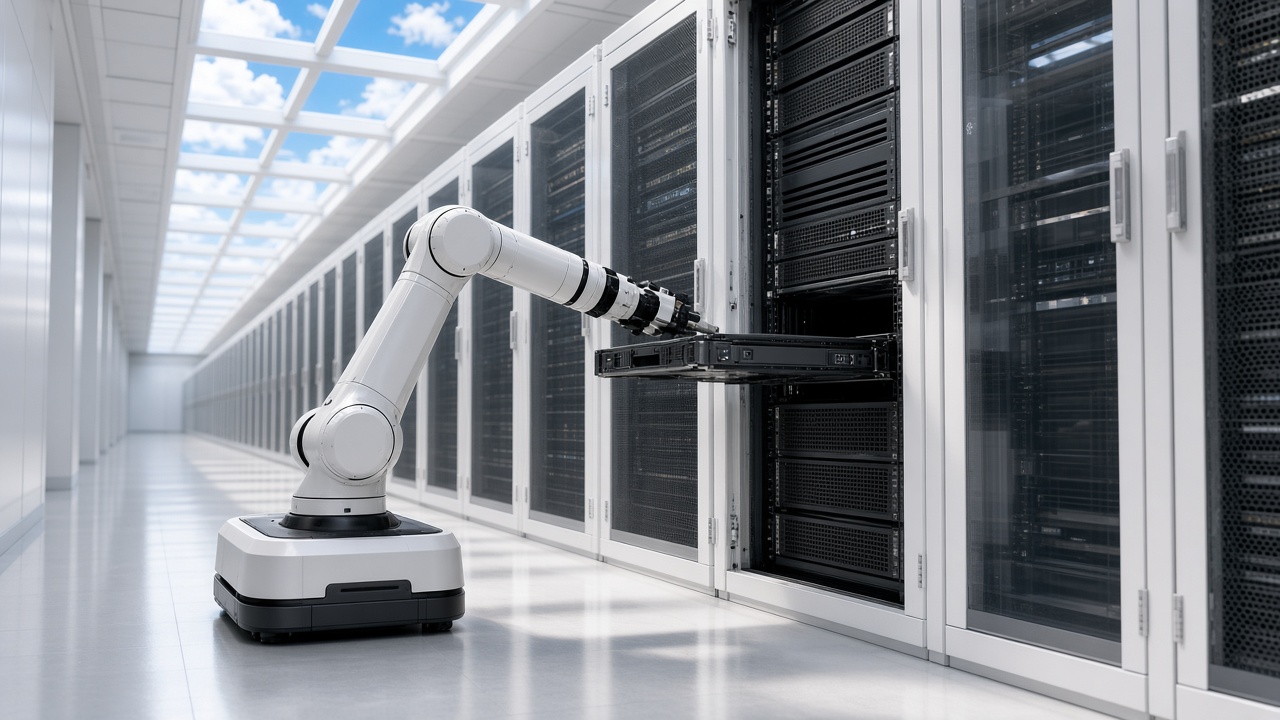
What each role does: data centre robotics engineers. Real October 2026 postings from Google, AWS and Graphcore, plus pay, skills and how to break in.
Welcome to the first post in a new series on AutomationRoles.ai: what each role does. Each instalment takes one job that's growing fast in automation and AI, explains what the work actually involves, who's hiring, what it pays and how to break in.
I'm starting with a role that barely existed as a job title a few years ago and is now showing up at some of the biggest names in tech: the data centre robotics engineer.
Why data centres need robots
The AI boom is physical. Every model runs on racks of servers and accelerators that have to be installed, cabled, inspected, repaired, swapped out and eventually decommissioned. At the scale the hyperscalers are building, doing all of that by hand is slow, expensive and error-prone. So the companies running the biggest AI fleets are now hiring engineers to automate the data centre itself.
This is exactly the kind of role I love writing about: tech-forward, hands-on and genuinely new.

Who's hiring right now
Here are real postings from October 2026 that show what this work looks like.
Google: Principal, Hardware, Data Centers Robotics
Google's AI and Infrastructure team posted a principal engineer role in Sunnyvale, California, on 7 October 2026. The job is to lead the strategy and technical development of data centre hardware robotics: automation that supports hardware deployment, repair operations and final decommissioning. The posting describes overseeing end-to-end deployment of autonomous mobile robots (AMRs), automated guided vehicles (AGVs) and multi-axis robotic arms for handling delicate data centre hardware.
The listed US base range is $275,000–$382,000, plus a 30% bonus target, equity and benefits. Minimum qualifications include a PhD in robotics or a related field, or equivalent practical experience, and 15 years in robotics systems engineering or architecture.
What really caught my eye is the preferred qualifications list: vision-language-action (VLA) models, imitation learning and reinforcement learning pipelines for teaching robots to manipulate objects; low-latency teleoperation and human-in-the-loop systems; and a practical understanding of general-purpose bipedal or wheeled humanoid platforms for data centre tasks. That's a clear signal of where Google sees this heading.
Graphcore: Staff Robotics Engineer
Graphcore, part of the SoftBank Group, published a Staff Robotics Engineer role in Austin, Texas, on 7 October 2026. Reporting to the Director of Automation, the engineer leads design, integration, validation and deployment of robotic automation for data centre operations, working with SoftBank Robotics and external partners. Example systems listed include robotic manipulation, material transport, inspection, rack and server handling, and autonomous mobile robots.
AWS: Datacenter Robotics
AWS has been hiring for its DC Robotics team in Seattle, which the posting describes as "growing in maturity". The work includes building systems that operate in AWS data centres and collect rich sensor data at scale, and the team is also seeking a generalist machine learning engineer to turn robot-collected imagery, LiDAR and thermal streams into reliable outputs. The posting expects roughly 30% travel to offices, data centres, suppliers and validation tests.
The adjacent roles: physical AI and humanoids
The same skills open doors to the humanoid and physical AI wave. OpenAI is hiring a Compute Electrical Engineer, Robotics in San Francisco to develop the AI inference compute systems that power its humanoid robots, covering compute architecture, high-speed interfaces such as PCIe and DDR, onboard power electronics and HDI PCB design. Renesas Electronics posted a Staff Engineer, Software – Physical AI in Farmington Hills, Michigan, providing technical leadership for humanoid robots, autonomous systems and embodied AI on its R-Car SoCs.
What the job actually involves
Pulling those postings together, a data centre robotics engineer typically:
- Scopes the problem. Which tasks (server swaps, cable work, inspection, material moves) are worth automating, and what the safety and uptime constraints are.
- Designs and integrates systems. Mobile bases, arms, grippers, sensors and software, tuned for fragile, expensive hardware in tight aisles.
- Builds the perception and learning stack. Computer vision, sensor fusion, and increasingly imitation learning and VLA models so robots can handle variation rather than follow rigid scripts.
- Deploys and validates in the field. This is not a lab-only role. Expect time on data centre floors, at partner sites and in validation tests.
- Keeps humans in the loop. Teleoperation and remote intervention systems for the cases robots can't yet handle.
Skills and backgrounds that get you in
From the postings above, the recurring requirements are:
- robotic control, motion planning, kinematics and mechatronics
- embedded systems (RTOS, microcontrollers, FPGA), sensor fusion and actuator control
- ROS or similar robotics frameworks
- machine learning for perception and manipulation: model fine-tuning, evaluation, data pipelines
- for hardware-leaning roles, high-speed digital design, power electronics and PCB layout
The Google role sets a very senior bar, but the wider ecosystem needs engineers at every level. If you're coming from warehouse automation, industrial robotics, manufacturing automation or autonomous vehicles, your experience transfers directly. If you're a data centre technician with a knack for scripting and hardware, there's a strong case for moving into robotics operations and deployment as these teams grow.
How to break in: my practical advice
- Build a portfolio robot. A mobile manipulator in simulation, then on a cheap real platform, doing a pick-and-place task with fragile objects. Show the failure cases and how you fixed them.
- Learn the data centre. Understand racks, power, cooling and hardware lifecycle. Robotics engineers who speak data centre operations are rare.
- Get comfortable with learning-based robotics. Imitation learning and VLA models feature in the preferred qualifications at Google for a reason.
- Be ready to travel and get your hands dirty. AWS flags around 30% travel. Field deployment is where you earn your stripes.
- Target the ecosystem, not just the giants. Integrators, robot makers and chip companies building for this space all need people.
My take
This is one of the most exciting intersections in tech right now: AI building the infrastructure for AI. It combines robotics, machine learning and hard infrastructure engineering, it pays very well at the top end, and it's early enough that people who move now can shape the field.
Is it hype-proof? No role is. But the demand is grounded in something very concrete: there are more racks to install and maintain than there are people to do it. That's a durable reason to hire.
Next in the series we'll look at another fast-growing automation role. In the meantime, browse automation and AI jobs on AutomationRoles.ai and search for robotics.
Sources: Google job posting via AI Chopping Block (7 October 2026); Graphcore careers on Greenhouse (7 October 2026); AWS DC Robotics posting (October 2026); OpenAI careers; Renesas Electronics careers on SmartRecruiters (7 October 2026).