Humanoid Robots Get Real: October 2026 News and the Jobs It Creates
GXO expands Agility's Digit, Schaeffler opens a humanoid factory, NVIDIA upgrades Isaac. What October 2026's humanoid news means for robotics careers.
For the last few years, humanoid robot news has mostly meant viral videos: backflips, dance routines, a robot folding a T-shirt very slowly. October 2026 felt different. The headlines this month were about multi-site contracts, factory lines, order books and training centres. In other words, the boring stuff that turns a technology into an industry, and an industry into jobs.
Here is what happened, what I think it means, and where the careers are heading.
GXO and Agility move from one site to a network
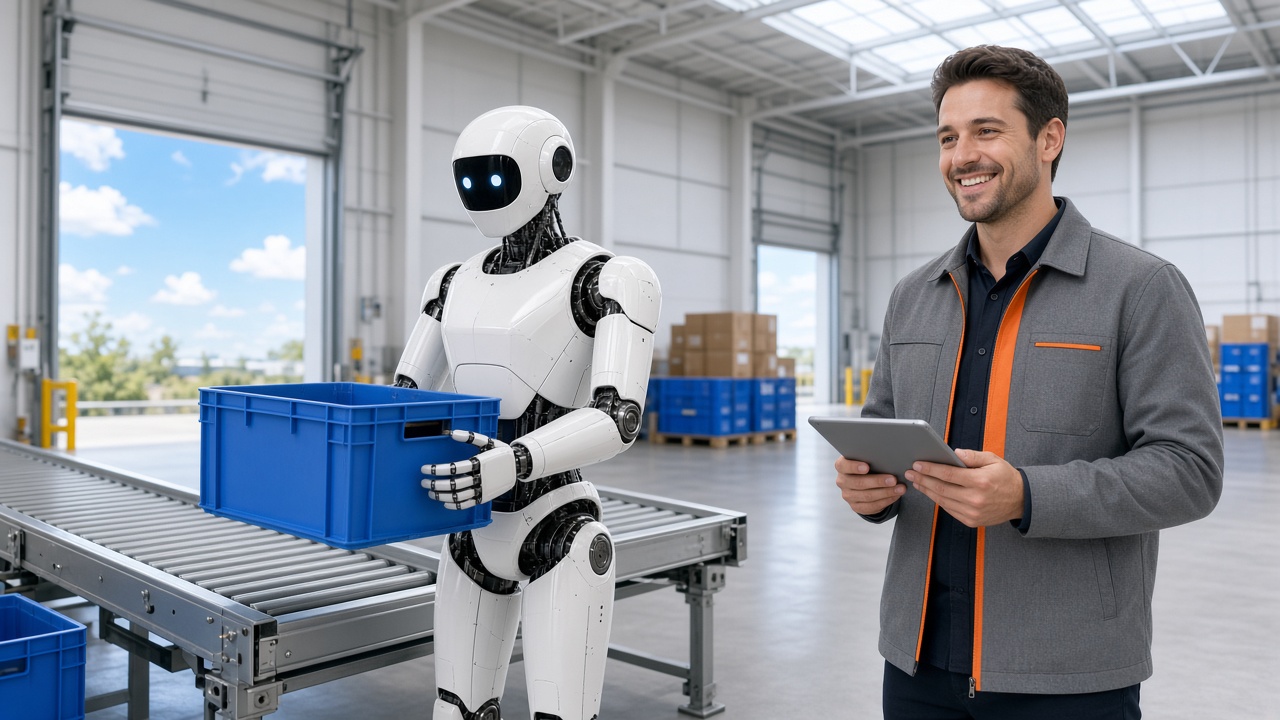
The clearest signal came on 26 October, when GXO and Agility Robotics announced an expanded partnership to deploy Agility's Digit humanoid at GXO sites in Statesville, North Carolina, and Lebanon, Tennessee.
Context matters here. GXO and Agility signed what they describe as the industry's first formal commercial deployment of humanoids in live operations, and the first Robots-as-a-Service agreement for humanoids, back in June 2024 at Flowery Branch, Georgia. Since then, Digit has moved more than 100,000 totes at that site. Across all its customers, Digit has logged more than 65,000 hours of real-world operation. The new deployments are due to start in early 2027 with Digit 4, then move to Digit 5, which Agility unveiled on 15 September and designed for safe work in close proximity to people.
On an investor call the same day, Agility CEO Peggy Johnson said the company had secured a $300 million Digit 5 order (subject to contractual milestones), $200 million in committed capital led by Foxconn, and a pipeline of 30 prospective customers, targeting 100 customers by the end of 2027. She also said Agility is aiming for up to 25 committed customer facility deployments by end of 2027, compared with nine today.
My read: one pilot is a science project. A second and third site with the same customer is a business decision. Logistics operators do not expand anything unless the numbers stack up, and that is the real headline.
Humanoids making humanoids in Taicang
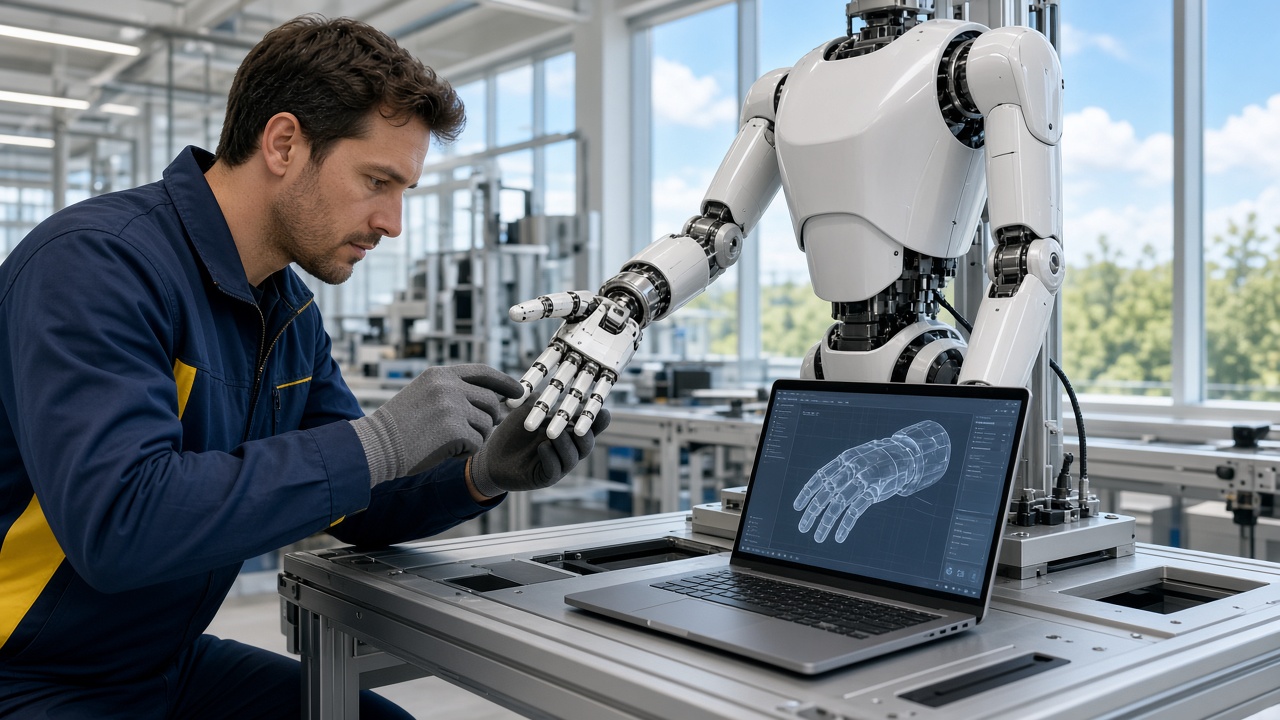
On 20 October, Schaeffler opened a "lighthouse factory" for humanoid robotics in Taicang, China. The 7,500 square metre site combines an assembly line, a training and data acquisition centre, a digital twin platform and a data centre.
The bit that grabbed everyone's attention: six humanoids working across five stations to stage, sort, join, inspect, label and package key joint modules, including actuators, for the next generation of humanoid robots. A digital twin mirrors the line in real time, tracking assembly accuracy, step duration, energy use and asset condition. Schaeffler says the factory marks the start of mass production of these components, and that its global incoming orders for humanoid robotics have risen to around 400 million euros.
This matters because it shows the supply chain maturing. When a major motion technology supplier builds dedicated production for actuators and joints, it is betting on volume, not on a handful of prototypes.
NVIDIA and Agile Robots push the developer stack
On 21 October at GTC, NVIDIA expanded its Isaac robotics platform with a new Isaac OS runtime, Isaac Lab 3.0 for robot learning, and open reference workflows for generating robot data, training and evaluation. NVIDIA named ABB Robotics, KUKA, NEURA Robotics, Universal Robots, Hexagon Robotics and others in Europe as building on its open robotics platform.
Alongside it, Agile Robots launched Agile ONE SN, a compact research humanoid built on NVIDIA Isaac GR00T and Jetson Thor. It stands 1.4 metres tall, has 31 degrees of freedom in the body plus two 20-degree-of-freedom tactile hands, and carries up to 3 kg per arm. NVIDIA says it cuts setup time from weeks to days, with interest from institutions such as Stanford and ETH Zurich. It is due in early 2027.
Why care if you are not a researcher? Because standard platforms are how a field scales. When every lab and startup is no longer hand-building its own simulation, training and deployment glue, more of the talent goes into making robots useful, and more companies can afford to try.
The rest of a very busy month
A few more stories worth knowing, via the IEEE Robotics and Automation Society's October roundup and the Robotics 24/7 October recap:
- RobCo hit a US$1 billion valuation after selling US$40 million of shares, and plans to launch Alfie, a two-armed self-learning industrial robot, in March 2027.
- TUM RoboGym opened in Munich, a collaboration between the Technical University of Munich's MIRMI institute and NEURA Robotics, where around 100 humanoid and service robots will initially learn skills in 48 training cells.
- Boston Dynamics named Rohit Prasad as CEO and unveiled new dexterous hands for its Atlas humanoid.
- Agility also announced a pilot of Digit for smart manufacturing with AGCO, and a safety partnership with FORT Robotics.
To keep my own optimism honest, Robotics 24/7 also flagged a sharp piece by Lars Talbert asking how much of the humanoid boom is orders versus actual deployments. That is the right question. Orders are subject to milestones, and an early 2027 start date is still a plan. But the direction is unmistakable.
What this means for jobs
This is the part I care about most. Every one of these stories creates demand for people, and not only PhDs.
Deployment and field roles. Multi-site rollouts like GXO's need robotics deployment engineers, field service technicians and site integration leads who can get a robot working alongside conveyors, warehouse management systems and human teams. Agility's Arc fleet platform, for example, is all about integrating robots into customer operations. Someone has to do that integration on the ground.
Manufacturing and quality roles. Schaeffler's Taicang line needs automation engineers, actuator and mechatronics specialists, quality engineers, and digital twin engineers who can turn sensor data into faster, more stable production.
Robot learning and simulation roles. NVIDIA's Isaac Lab, GR00T workflows and places like TUM RoboGym run on simulation engineers, robot learning researchers, data collection operators and ML engineers who know how to close the gap between sim and real.
Safety and evaluation roles. Digit 5 is designed for close work with people, Agility is partnering on safety, and NVIDIA is integrating its Halos safety stack. Functional safety engineers and robot evaluation specialists are going to be in serious demand. If that interests you, our new guide to what an AI evaluation engineer does is a good companion read.
You can already see this in the listings. On AutomationRoles.ai right now we have roles including a Machine Learning Engineer for Humanoid Robotics at NVIDIA in Shanghai, a Robotics and Physical AI Developer Support Engineer at Intel in Bangalore, and a Senior ML Engineer, Robotics, Special Projects at Apple in Santa Clara. Browse the full list on the jobs board.
My advice if you want in
If you are a technician or tradesperson: you are closer than you think. Mechatronics, PLCs, electrical fault-finding and warehouse automation experience transfer directly to humanoid deployment and service. Get hands-on with a cobot or AMR if your employer has them, and learn the basics of ROS 2.
If you are a software or ML engineer: pick up simulation. Isaac Lab, MuJoCo or similar, plus some reinforcement learning or imitation learning, will set you apart. A small public project showing a policy trained in sim and tested on even a cheap robot arm is gold.
If you are in operations or logistics: the people who know how a warehouse actually runs are going to be critical in deciding where robots fit and how to measure their value. Learn the language of robots-as-a-service, uptime and throughput per hour.
For everyone: follow the deployments, not the demos. A company announcing its second and third live site is usually a better hiring signal than a slick video.
The bottom line
October 2026 was the month humanoids started to look like an industry rather than a sideshow. Real contracts, real production lines, real order books and real training infrastructure. There is still plenty to prove in 2027, and I would treat any single number with healthy caution. But the talent demand is already here, and it is broad: engineers, technicians, safety specialists, simulation experts and operators.
If you have been waiting for a sign to move into robotics, this is it. Set up a job alert on AutomationRoles.ai and start building the skills now, because the robots are booked in for early 2027 and somebody needs to be ready to switch them on.